UWC Changshu · Student Portfolio

Liming Yang

Exploring flight,
from the ground up.

At seven, I fell in love with the way a model aircraft responded to my hands. That fascination is still with me. I want to become an airline pilot, bringing my curiosity about aircraft systems into a cockpit where anticipating what comes next and working with a crew matter to everyone on board.

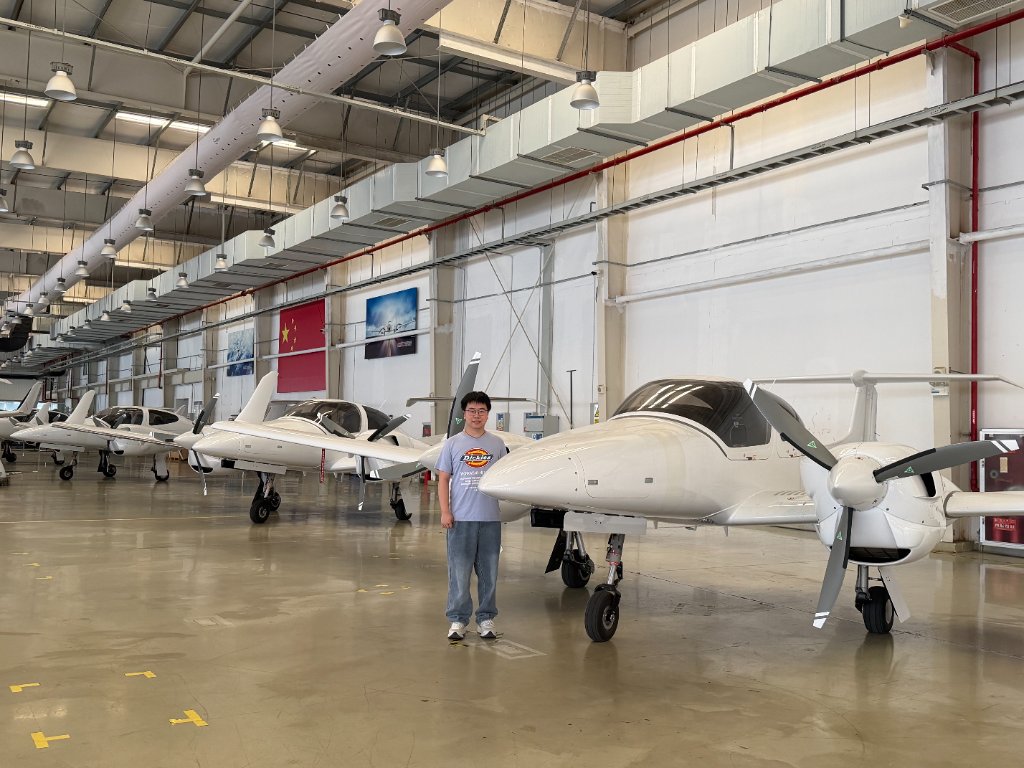
Liming standing beside an aircraft at the Diamond Aircraft facility
Diamond Aircraft internship

AVIATION JOURNEY

From Model Aircraft to the Cockpit

My interest in flight grew through building model aircraft, assembling first-person-view (FPV) systems, and testing wings in a wind tunnel. Later experiences in a cockpit and an aircraft factory gave those earlier lessons a different context.

01 / Origins

Learning to Fly and Build

Early model aircraft connected flying with making, adjusting, and trying again.

My First Fixed-Wing Aircraft

2014 — Primary School

Early fixed-wing model flying in Yuen Long

At a flying club in Yuen Long, Hong Kong, I was introduced to fixed-wing model aircraft. Bringing home my first small aircraft gave me something I could fly, examine, and keep learning from.

Flying gave me a reason to pay attention to how an aircraft responds to each control input.

Building My Own Airframe

Primary School — Grade 5

KT-board fixed-wing aircraft

With guidance from university students and experienced hobbyists, I built aircraft from KT-board foam. Cutting airframes, installing servos, and adjusting linkages made the relationship between construction and flight much easier to understand.

Flying Different Model Aircraft

Grades 6–7

Model aircraft from my early flying experiences

I later flew a wider range of models, including gliders, electric ducted-fan jets, and water-based aircraft. Their different handling characteristics made me pay closer attention to speed, wind, and the conditions of each flight.

02 / FPV & Systems

Understanding the Whole System

FPV building, setup, assessment, and competition expanded what I needed to understand before and during flight.

Building and Tuning FPV Aircraft

Middle School

FPV flying with goggles and a transmitter.

I began assembling FPV aircraft from individual components and configuring them for flight. The work connected electronics and software setup with the aircraft's behavior in the air.

Reliable flight depended on how the components worked together, as well as how I controlled the aircraft.

  1. Build

    Frames, motors, flight controllers, and the video system.

  2. Configure

    Firmware setup and flight-controller tuning in Betaflight.

  3. Check

    Motor direction, battery condition, and failsafe behavior.

Assessment and Competition

2020–2021

Practical UAV flight assessment.

A multirotor UAV assessment and FPV racing competitions introduced formal standards and performance under pressure. Preparation, rule awareness, and consistent flying became part of how I approached each event.

03 / Aerodynamic Research

Testing the Ideas Behind Flight

Building a wind tunnel gave me a way to investigate questions that had started with model aircraft.

Building a Wind Tunnel, Then Questioning the Measurements

High School — Grades 10–11

Wind tunnel aerodynamic testing setup

I built a small wind tunnel to investigate wing performance using lift measurements, tufts to visualize airflow, and computational fluid dynamics (CFD) simulations. The platform later supported a study of how wing aspect ratio affects the lift-curve slope at small angles of attack.

I had to understand how the measuring system affected the result before interpreting what the wing was doing.

  1. Notice the interference

    Airflow around the support structure affected the measurements.

  2. Refine the setup

    I added a shielding disk around the mounting area.

  3. Consider the limits

    The change addressed a source of interference; experimental uncertainty still remained.

04 / Cockpit & Industry

Connecting the Cockpit and the Factory

A supervised cockpit experience and an aircraft manufacturing internship connected earlier interests with real aircraft operations and production.

Inside a CTLS Cockpit

High School — Grade 11

Cockpit view during the CTLS fisheries patrol flight.

I joined a CTLS fisheries patrol flight as a passenger-observer and briefly handled the controls during cruise under the pilot's supervision. The cockpit gave me first-hand exposure to how aircraft control, instrument monitoring, route awareness, and communication fit together during a flight.

Handling the controls was one part of a larger task: keeping track of the aircraft and its surroundings.

Seeing How Aircraft Are Built

High School — Year 3

At the Diamond Aircraft facility during my internship.

During an internship at Diamond Aircraft, I gained first-hand exposure to aircraft production, avionics installation, and quality checks. Seeing these processes together helped me connect the aircraft I knew from flying and research with the work required to build and inspect one.

Manufacturing made the connection between a technical detail and the aircraft's dependable operation more tangible.

Community at UWC

UWC kayaking community gathered together on the water

KAYAKING & LEADERSHIP

Learning alongside others.

At UWC Changshu, I help lead a kayaking community. Planning sessions, responding to different levels of experience, and giving others room to contribute have shaped how I work with people.

Explore the kayaking story
Conceptual architectural model illustrating dorm allocation

DORM ALLOCATION & TRANSPARENCY

Making room for choice.

Conversations with school staff revealed the practical challenges behind dorm allocation. I explored solutions with AI and used Base44 to build a prototype that makes capacity, student preferences and community priorities easier to review. Demonstrating it to staff helped me understand what a useful tool must account for.

Explore the dorm allocation story

© 2026 Liming Yang — Learning through flight, systems, and responsibility